You’ve likely experienced how quickly rice transforms from a fluffy side dish into an unsafe bacterial breeding ground when left at room temperature too long. Don’t let this common kitchen mistake compromise your leftover rice safety. While some foods can withstand brief periods outside refrigeration, rice demands immediate attention due to Bacillus cereus spores that multiply rapidly between 40-140°F. You’ll need to act fast—but what steps matter most?
Why You Shouldn’t Leave Rice Out Overnight
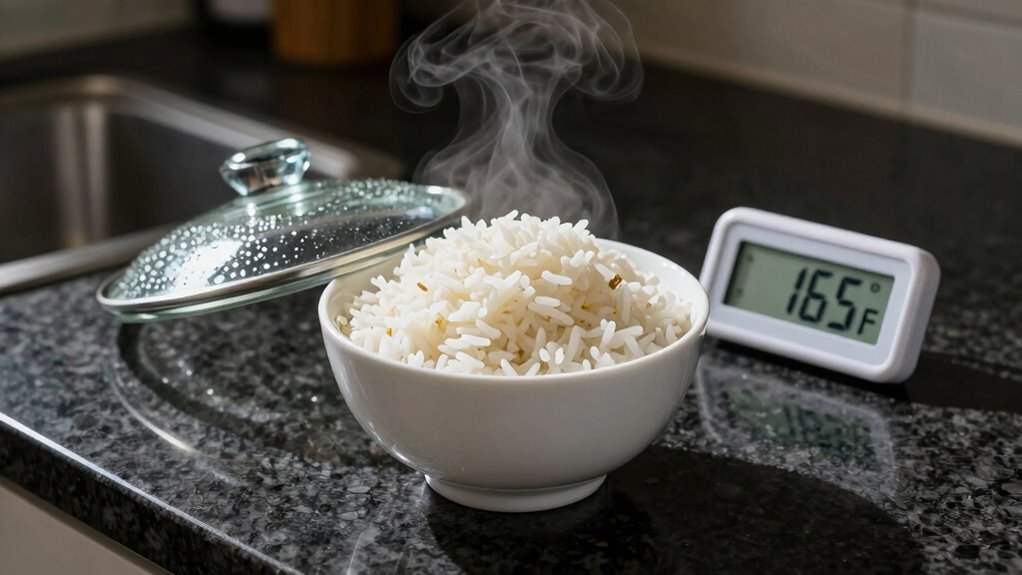
When you leave cooked rice out at room temperature overnight, you create ideal conditions for Bacillus cereus bacteria to multiply rapidly and produce toxins that can cause food poisoning.
These bacteria spores survive cooking and germinate quickly between 40-140°F. You shouldn’t risk your health or your family’s wellbeing by consuming contaminated rice.
The bacteria produce two types of toxins: one causing vomiting within hours, another leading to diarrhea lasting up to 24 hours. Symptoms include nausea, abdominal cramps, and dehydration requiring medical attention.
Your body’s immune system struggles fighting these pathogens when they’re present in high concentrations. You must understand that reheating won’t destroy preformed toxins already circulating in the rice.
Making safe food storage choices shows you care about protecting everyone who eats meals you prepare, creating trust through responsible kitchen practices.
Cool Rice Fast to Prevent Bacteria Growth
You must cool rice rapidly using shallow containers or ice baths to prevent bacterial proliferation.
Select appropriate storage containers that facilitate quick heat dissipation while maintaining food safety standards.
Monitor rice temperature closely during cooling to guarantee it reaches safe storage temperatures within recommended timeframes.
Rapid Cooling Methods
Because bacteria thrive in warm, moist environments, cooling rice rapidly is essential for food safety. You must act quickly to prevent bacterial growth that causes foodborne illness.
- Spread rice thinly on large, clean trays or baking sheets immediately after cooking. This increases surface area exposure, accelerating heat dissipation.
- Use ice baths by placing covered rice containers in larger bowls filled with ice water. Stir occasionally until temperature drops below 70°F.
- Divide into smaller portions before cooling. Smaller amounts cool faster than large batches, reducing time bacteria have to multiply.
Monitor internal temperature with food thermometers. Rice must reach 70°F within two hours of cooking.
Don’t leave rice at room temperature longer than necessary. Your family’s health depends on proper rapid cooling techniques.
Proper Storage Containers
While rice cools rapidly through proper techniques, selecting appropriate storage containers becomes essential for maintaining food safety and preventing bacterial growth.
You must choose containers that seal tightly to prevent contamination and moisture loss. Glass or BPA-free plastic containers work best, as they don’t absorb odors or chemicals. Avoid storing rice in aluminum foil or plastic wrap alone, since these materials don’t provide adequate protection.
You should transfer rice to containers immediately after cooling, ensuring portions are shallow enough for quick temperature reduction. Stackable containers save space while maintaining organization.
Label each container with storage dates, as rice shouldn’t remain safe longer than four days. Don’t overcrowd containers, allowing minimal headspace for expansion.
Metal containers conduct heat rapidly but require careful handling. You must prioritize container integrity over convenience.
Temperature Monitoring Tips
Proper container selection directly impacts how quickly rice cools and maintains safe temperatures. You must monitor rice temperature closely to prevent bacterial growth that causes foodborne illness.
- Speed kills bacteria: Cool rice rapidly by spreading it thinly on baking sheets before transferring to containers. Rice enters the danger zone (40-140°F) where bacteria multiply exponentially.
- Time matters critically: Don’t let rice sit at room temperature longer than two hours. Bacterial spores activate quickly, producing toxins that refrigeration can’t eliminate.
- Precision prevents illness: Use thermometer probes to verify rice reaches 41°F or below within four hours. This rapid cooling protocol eliminates pathogenic bacteria before they establish dangerous colonies.
Monitor temperatures obsessively—your family’s health depends on it.
Best Containers for Overnight Rice Storage
Several container options work best for storing cooked rice overnight. You should choose airtight containers with tight-fitting lids to prevent moisture loss and contamination.
Glass containers offer excellent temperature stability and won’t absorb odors. BPA-free plastic containers provide lightweight convenience while maintaining food safety standards.
Metal containers aren’t recommended due to potential chemical reactions with acidic rice components. Your container must accommodate rice expansion during cooling without overcrowding.
Shallow containers promote faster, even cooling compared to deep bowls. You’ll achieve peak results using containers specifically designed for food storage rather than general household items.
Ascertain your chosen container allows proper ventilation during initial cooling while maintaining airtight seals afterward. Select containers that fit standard refrigerator shelving for convenient storage.
Fridge vs Freezer: Where to Store Rice
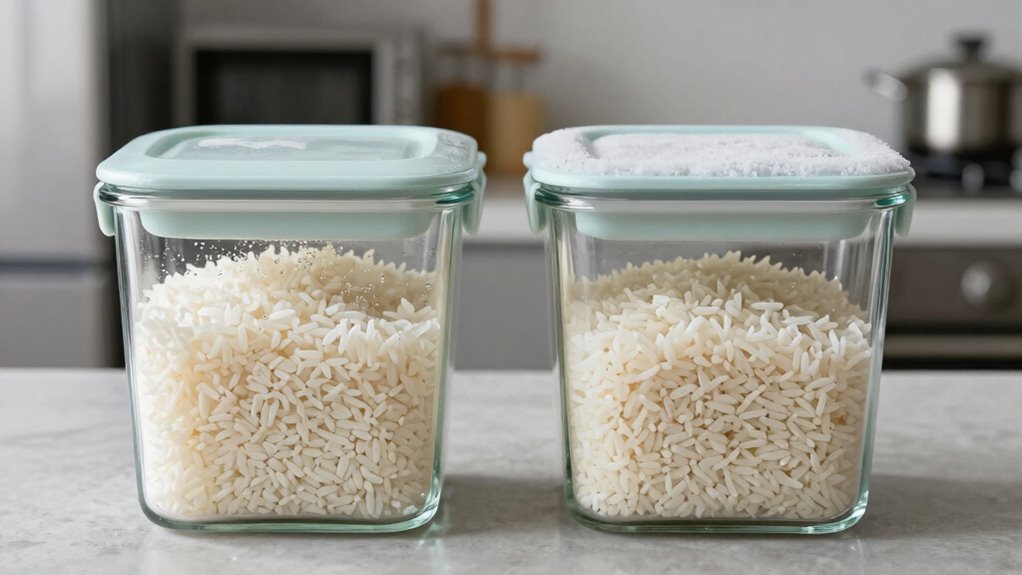
When storing cooked rice, you must choose between refrigeration and freezing based on your timeline for consumption.
Refrigeration maintains rice quality for 3-4 days, while freezing extends usability up to 6 months.
- Refrigerate rice if you plan consuming within four days – this preserves ideal texture and prevents bacterial growth effectively.
- Freeze rice immediately if you won’t eat it within a week – freezing halts microbial activity completely, guaranteeing safety.
- Label storage containers with dates – this prevents confusion and guarantees you use older rice first, maintaining food safety standards.
Temperature control matters considerably.
Refrigerated rice maintains moisture content better than frozen rice, which may experience texture changes during thawing.
Your storage choice directly impacts meal quality and safety outcomes.
How to Reheat Rice Safely
You must reheat rice to 165°F (74°C) to kill harmful bacteria like Bacillus cereus that can cause food poisoning.
Your microwave should heat rice in 30-second intervals with stirring to guarantee even temperature distribution and prevent hot spots.
Stovetop reheating requires adding two tablespoons of water per cup of rice and heating over medium-low heat while stirring constantly.
Proper Reheating Temperature
Maintaining proper reheating temperatures is essential for eliminating harmful bacteria that may have developed during rice storage. You must reach specific temperature milestones to guarantee food safety and protect your family’s health.
- Steam until 165°F internally – Your rice must reach this critical temperature to kill Bacillus cereus spores that cause food poisoning.
- Maintain consistent heat distribution – Stir continuously while reheating to eliminate cold spots where bacteria survive.
- Verify temperature with reliable thermometer – Don’t guess; confirm your rice hits the mark for everyone’s safety.
You’re not just reheating rice – you’re safeguarding your loved ones.
Proper temperature control transforms potentially dangerous leftovers into safe, comforting meals. Your family deserves this protection.
Microwave Safety Tips
Reaching the proper internal temperature of 165°F eliminates harmful bacteria, but achieving this safely in a microwave requires specific techniques that differ from stovetop methods.
You must use a microwave-safe container and cover rice with a damp paper towel to maintain moisture. Heat rice on high for one-minute intervals, stirring between each interval to guarantee even heating.
Check the internal temperature after each minute using a food thermometer. Rice heats unevenly in microwaves, creating cold spots where bacteria survive.
Never reheat rice more than once, as this increases bacterial growth risk. Stirring breaks up clumps and promotes uniform heating throughout the rice bed.
Stovetop Reheating Methods
While microwave reheating poses challenges with uneven heating patterns, stovetop methods offer superior temperature control for safely reheating rice. You’ll achieve consistent heating that eliminates cold spots where bacteria thrive.
- Add moisture immediately – Place rice in a saucepan with two tablespoons water per cup. Cover tightly and heat over medium-low heat, allowing steam to redistribute moisture you’ve lost during storage.
- Monitor temperature precisely – Use a food thermometer to verify internal temperature reaches 165°F throughout. Don’t rely on visual cues alone.
- Stir consistently – Break up clumps with a fork every thirty seconds, ensuring even heat distribution prevents bacterial growth zones.
Master these techniques, and you’ll join the ranks of cooks who reheat rice safely every time.
Signs Your Rice Is No Longer Safe to Eat
When stored rice develops an off smell or unusual texture, you should discard it immediately. Rice that smells sour, musty, or distinctly different from its original aroma indicates bacterial growth.
You’ll notice slimy or excessively hard textures when unsafe rice spoils. Visible mold spots appear as green, black, or white fuzzy patches requiring instant disposal.
Rice left at room temperature over two hours becomes hazardous due to Bacillus cereus spores multiplying rapidly. Even reheating won’t eliminate toxins already produced.
Trust your senses when evaluating rice safety. When in doubt, throw it out.
Proper storage in airtight containers within two hours of cooking prevents most spoilage issues. Your family’s health depends on recognizing these warning signs promptly.
Conclusion
Store leftover rice in airtight containers within two hours of cooking, then refrigerate immediately. Don’t leave rice at room temperature overnight—bacteria multiply rapidly. Sarah forgot her rice on the counter for eight hours; by morning, it had developed an off smell and slimy texture. Always check rice carefully before reheating. When in doubt, throw it out. Proper storage prevents foodborne illness.